UK guide
How to chase an overdue invoice in the UK.
A plain-English guide for UK sole traders and freelancers. The polite reminder ladder that actually gets you paid, your statutory right to interest, when to escalate, and how to do all of it without sounding like a debt collector.
The short version
Calm escalation in six steps.
1. Send a friendly reminder the day before due.
2. A polite reminder on the due date itself.
3. A polite follow-up at 3 days overdue.
4. A firmer reminder at 1 week overdue.
5. A firm follow-up at 2 weeks overdue.
6. A calm final reminder at 30 days overdue. After this, consider statutory interest, a Letter Before Action, or escalation.
The polite chase ladder
What to send, and when.
Most UK customers pay late by accident, not by intent. The right reminder treats them like a person, gives them an easy way out, and escalates only as quickly as needed.
Day −1
Friendly heads-up the day before due
Most late payments are accidents. A short, neutral reminder the day before due catches the customer who genuinely forgot. Keep it warm and one paragraph.
Day 0
Polite reminder on the due date itself
Restate the invoice number and amount. Include the easiest possible way to pay (payment link or bank details). Don't apologise for chasing.
Day +3
Polite follow-up at 3 days overdue
Add a single line acknowledging that they may have already paid. Most customers reply within 24 hours of this message.
Day +7
Firmer reminder at 1 week
Ask directly when you can expect payment. Still calm, still professional — but you're now asking for a date, not just a payment.
Day +14
Firm follow-up at 2 weeks
If silence continues, ask for payment at their earliest convenience, or for a reply with a definite settlement date. Suggest a phone call.
Day +30
Final reminder at 30 days overdue
A calm, factual final reminder. If this passes unpaid you may want to add statutory interest, send a Letter Before Action, or escalate further.
Your rights in the UK
What the law says about late payment.
General information, not legal advice. For your specific situation, talk to a solicitor or use one of the free services linked below.
Statutory interest (B2B)
For business-to-business invoices, the Late Payment of Commercial Debts (Interest) Act 1998 entitles you to interest at 8% above the Bank of England base rate, plus a fixed compensation amount. The right is automatic — you don't need it in your contract. Full GOV.UK guidance →
Letter Before Action
Before issuing a court claim, the expected step is a formal Letter Before Action giving the debtor a final deadline (usually 14 or 30 days). Free templates and guidance are available from Citizens Advice and the Federation of Small Businesses.
Money Claim Online
For undisputed debts up to £10,000, GOV.UK's Money Claim Online service lets you file a county court claim digitally. Most cases settle before a hearing once the claim is filed.
Citizens Advice & FSB
Free guidance for UK sole traders and small businesses is available from Citizens Advice and the Federation of Small Businesses. Use them before paying for legal representation.
Automate the polite bit
DueTidy handles the first 30 days for you.
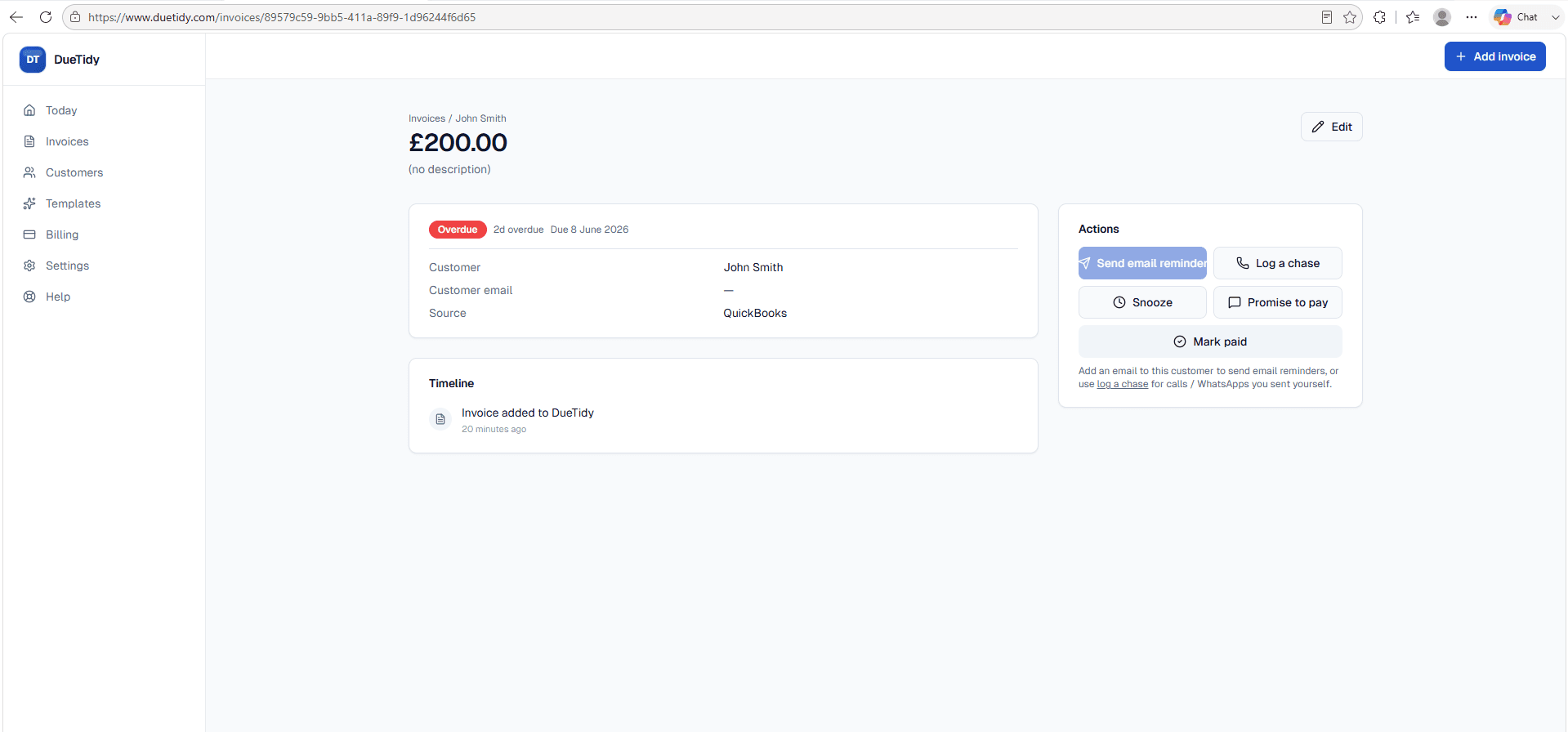
Add the invoice. DueTidy sends the polite reminder ladder above automatically (or as drafts you review). After 30 days, you'll have a clean record of every chase — useful whether you escalate, settle, or move on.
- Send polite email reminders on a sensible schedule
- Log phone calls, WhatsApps and texts alongside
- Snooze an invoice if the customer asks for time
- Promise-to-pay tracking when they commit to a new date
FAQ
Common questions about chasing late invoices in the UK.
Can I charge interest on a late invoice in the UK?
If the debt is business-to-business, the Late Payment of Commercial Debts (Interest) Act 1998 gives you a statutory right to interest (currently 8% above the Bank of England base rate) plus a fixed compensation amount that scales with the invoice value. You don't need it written into your contract — the right is automatic. Consumer (B2C) invoices are different and usually need a contractual clause.
What is a Letter Before Action?
A Letter Before Action (or Letter Before Claim) is the formal letter you send before issuing a county court claim. It gives the debtor a deadline (usually 14 or 30 days) to pay or respond, and it's an expected step before going to court. There are templates online — but if you're considering this step, also speak to a solicitor or visit Citizens Advice for free guidance.
What about small claims court?
For undisputed UK debts up to £10,000 you can use the Money Claim Online service (gov.uk/make-money-claim). The fee depends on claim size. Most cases settle before a hearing once the claim is filed. This is a step you'd take after the polite chase ladder above has failed.
Is there a polite way to ask for payment that actually works?
Yes — and there's evidence behind it. Short, calm, factual messages outperform long apologetic ones and aggressive ones in roughly equal measure. Reference the invoice number, restate the amount, acknowledge they may have paid, offer the easiest payment route. DueTidy's six default templates use this exact pattern.
When should I escalate?
Escalation should be considered after the 30-day reminder if there's been no response or contact. Before that, the conversation is more likely to recover the money and preserve the relationship. After it, you're choosing between writing it off, formal recovery, or a debt purchase agency.
Should I add late payment fees?
B2B: yes — the statutory right above applies automatically. B2C: only if it's in your contract or terms. Either way, mentioning the fee in the final reminder often prompts payment faster than the fee itself ever earns.
Stop chasing manually. Run the polite ladder on autopilot.
Add your first overdue invoice and DueTidy sends the rest.
No card required · Cancel anytime